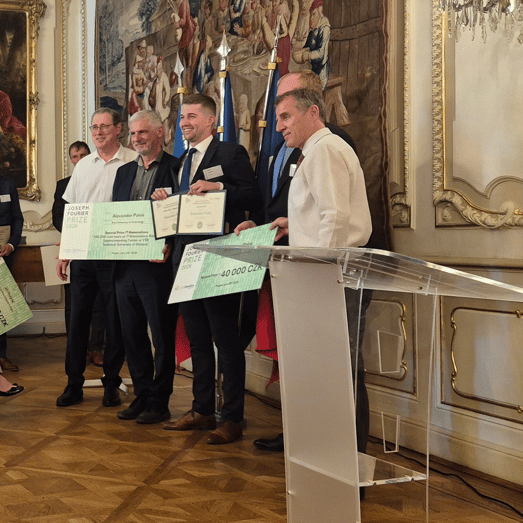
Bull was honoured to sit on the jury of the Joseph Fourier Prize. With this prize, Bull and the French Embassy in the Czech Republic award high-level PhD research work in computer sciences in the following areas: artificial intelligence, computer systems and networks, cybersecurity, database systems, human computer interaction, vision and graphics, numerical analysis, programming languages, software engineering, bioinformatics and theory of computing.
The jury has chosen to recognise several innovative projects:
1st place - Jiří Horyna: decentralised drone swarms that keep working with no GPS or radio
2nd place - Alexander Polok: transcribing who said what when several people talk at once, across languages
3rd place - Martin Šubrt: detecting the earliest signs of Parkinson's from a phone call
Special IT4Innovations award presented by the IT4Innovations National Supercomputing Center at the Technical University of Ostrava - Alexander Polok
The level of research presented at this year's prize, organised by the French Embassy, confirms the Czech Republic's position as a hub for cutting-edge computer science. These young scientists are developing solutions that will shape the future of AI and high-performance computing. With AI moving this fast, these are the people who belong at the front.
Alexander Polok transcribes who said what when several people talk over each other, even across languages. He's the first to do it by tracking who is speaking when, an approach he calls diarisation conditioning and NVIDIA's own researchers have already cited it. More here.
Michal Piňos makes computer vision run on far less power, so it can fit on small, low-power devices. He's the first to combine two existing power-efficiency methods for designing convolutional neural networks, and crush the efficiency numbers. More here.
Eva Mikušová reconstructs clean 3D images of molecules, the kind used to design new drugs, from the brutally noisy data a microscope produces. Her advance is a GPU version of hybrid LSQR that runs at the full scale of real cryo-EM data. More here.
Martin Šubert detects the earliest signs of Parkinson's in the way a person speaks. He's the first to predict from everyday speech who will develop the disease years before diagnosis, using digital biomarkers read from a single phone call. More here.
Jiří Horyna enables swarms of drones to keep working with no GPS, no radio link, and nothing to guide them from outside. It is the first fully decentralised swarm to do it: the drones hold formation just by watching one another, proven with up to twenty in open desert. More here.
Petr Illner works out, exactly, how many valid solutions a system with millions of conditions can have: the maths behind dependable configuration and diagnosis. His is the first symmetry-breaking model counter to enter the internationally recognised Model Counting Competition, presented at the SAT Conference, and it tied for second on its debut. More here.
Tomáš Nováček lets you use your bare hands in virtual reality, no controllers, tracked precisely enough for fine, professional work. He surrounds you with several optical sensors that cover each other's blind spots, then fuses their feeds in real time, weighting each by how far it can be trusted, developed in collaboration with the VR maker VRgineers. More here.
Šimon Schierreich makes fairness in collective decisions something you can measure. Take participatory budgeting, where residents vote on how to spend part of a city budget: instead of a bare "funded or not", his measures tell a proposer richer feedback: how much cheaper the project needed to be, who is the key rival project and more. More here.